Pinocchio works to support Geppetto
The Adventures of PinocchioPinocchio’s work to support Geppetto marks a decisive change from disobedient flight to sustained responsibility. When he finds his father again, care is no longer a promise made in a moment of emotion: it becomes a daily routine of labor, practical invention, and study that helps restore Geppetto’s health and changes Pinocchio’s own habits.
From reunion to responsibility
After escaping the Shark, Pinocchio follows a distant light and finds Geppetto alive, seated at a table and eating live fish. The reunion is overwhelming: Pinocchio embraces his father and declares that he will never leave him again. But the immediate need is not simply to celebrate. Geppetto is old and in poor condition, and Pinocchio asks the Talking Cricket where he can find milk for him.
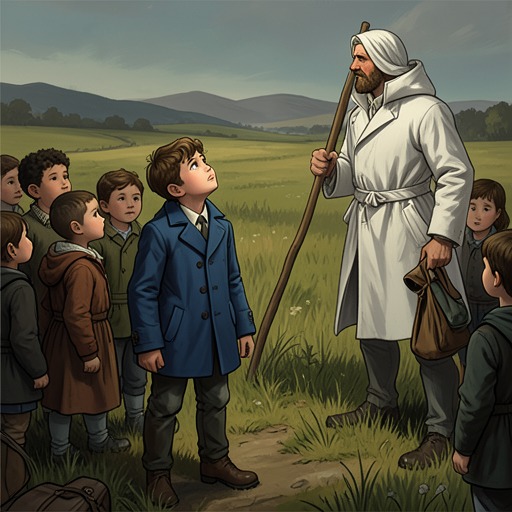
The Talking Cricket directs him to Farmer John, three fields away, where cows can provide the milk. At the farm, Pinocchio discovers that need alone will not secure it. Farmer John first tells him that without a penny there can be no milk, then proposes an exchange: Pinocchio can draw water from a well, and in return he will receive a glass of warm, sweet milk. The arrangement turns his wish to care for his father into a concrete task with an immediate purpose.
The first day’s labor
Farmer John shows Pinocchio how to draw water and sets him to hauling one hundred buckets. Pinocchio agrees, but the work quickly exhausts him. Long before the hundredth bucket, he is tired and dripping with perspiration; he has never worked so hard in his life. The plain physical difficulty matters: his new responsibility does not arrive as an easy reward for good intentions. It begins with effort he has not previously had to sustain.
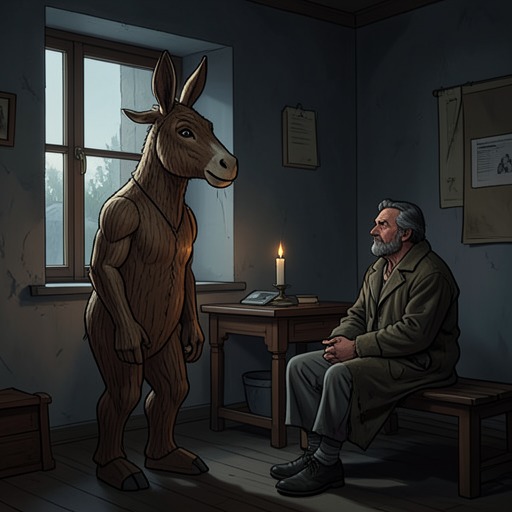
In exchange, Pinocchio receives the promised glass of milk and carries it back to Geppetto. At the farm he also learns that the donkey who used to draw the water is dying. When he asks to see the animal, Farmer John jokes about Pinocchio’s supposed schooling. Pinocchio is ashamed and hurt, but does not answer. The episode places his work beside an uncomfortable reminder of the gap between the education he might have had and what he has actually learned so far.
A routine of work and care
The first exchange grows into a lasting commitment. For more than five months, Pinocchio rises every morning at daybreak and goes to the farm to draw water. Each day he earns a glass of warm milk for Geppetto, who grows stronger and better. The repeated journey makes the change measurable: Pinocchio’s care is not a single generous gesture but a routine maintained over time, with his father’s recovery as its visible consequence.
He takes on more work as well. Pinocchio learns to make baskets from reeds and sells them, using the money to help himself and Geppetto avoid starvation. He also builds a strong, comfortable rolling chair so that his father can go out for an airing on bright, sunny days. These acts answer different needs: the milk supports Geppetto’s recovery, the baskets help provide for their household, and the chair gives the old man a means of getting outside. Pinocchio’s labor becomes resourceful rather than merely dutiful.
Study, independence, and change
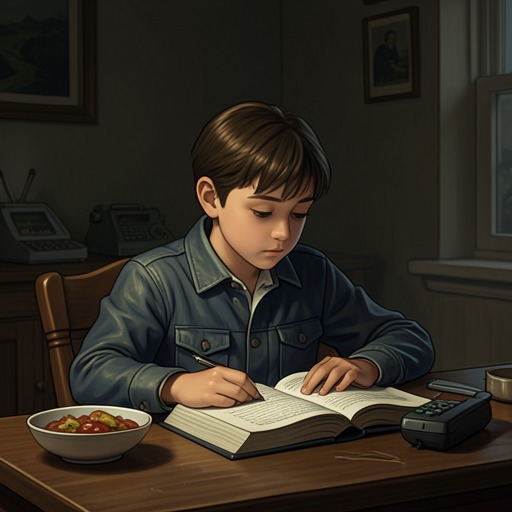
Work does not displace learning. In the evenings Pinocchio studies by lamplight, buying a secondhand volume with some of his earnings. Although several pages are missing, he uses the book to learn to read in a short time. For writing, he whittles a long, fine point on a stick and uses the juice of blackberries or cherries for ink. The makeshift tools give his education a material form: he does not wait for ideal conditions but finds a way to practise with what he can obtain.
Little by little, Pinocchio succeeds both in his work and in his studies. He earns enough to keep Geppetto comfortable and happy, and eventually saves fifty pennies. He plans to spend them on a coat, a cap, and a pair of shoes for himself. That intention does not undo the care he has shown; it shows that responsibility and personal hopes now coexist. The boy who once failed to value the book bought at his father’s expense has learned through labor to support his father and to pursue an education of his own.
Significance
This episode gives Pinocchio’s moral change a practical measure. His devotion is expressed through dawn visits, a hundred buckets of water, baskets made for sale, a chair built for Geppetto, and study continued at night. The sequence links filial care with self-education: supporting his father requires persistence, while the habits acquired through that work also make Pinocchio more capable and independent. Geppetto’s gradual recovery and Pinocchio’s growing competence are parallel consequences of the same sustained effort.